
The Maya Calendar Explained | What Is the Maya Calendar? The 13 Moon Calendar Helps You Understand Yourself in This Lifetime
Mayan Lazybones Catalog
- What is the Mayan Calendar?
- Is the Mayan Armageddon real?
- "What is the difference between the Mayan Calendar and the Mayan 13th Lunar Calendar?
- Maya 13 What is the significance of the totems and tones in the lunar calendar?
- Maya 13 What is the difference between the lunar calendar and the Western calendar?
- Where do I look up the Mayan calendar?
- Who can I call to interpret my own Mayan calendar?
What is the Mayan Calendar?

If you type "Mayan 13 Moon Calendar" in the Google search bar, a whole row of search results will usually pop up showing "The 13 Moon Calendar is derived from the ancient calendar used by the Mayans ......" But, how much do you know about this ancient calendar?
"The Mayan Calendar is a system of calendars used by the Mayan people that dates back to 3114 BC, more than 5,000 years ago. The entire calendar is divided into three parts: the Zolkin Calendar, the Habu Calendar, and the Long Calendar.
Similar to the Heavenly Stems and Earthly Branches, which are familiar to Taiwanese, the Zolkin and Habu calendars are combined with each other to form a cycle of fifty-two years. Each time the cycle passes, the same combination of calendars is repeated.
Zoll Gold Calendar
"The Zolkin Calendar is now generally recognized as a predominantly religious calendar whose logic has nothing to do with astronomical or natural cycles.
This calendar consists of 20 calendar characters and 13 numerals to form a 260-day calendar, with a total of 260 characters. Each character has a corresponding meaning, so the character corresponding to each birthday can also be used to analyze the child's possible future career and life development, and is generally considered to have both prophetic and divinatory functions.
Habu calendar
"The Habu Calendar is the solar calendar used by the Maya and is the basis of the Farmer's Calendar. There are twenty days in a month and eighteen months in a year, and the remaining five days are called "Wayeb'" and form a complete year of 365 days.
During Wayeb', the boundary between the human world and the netherworld disappears, and evil spirits from the netherworld come to the human world to wreak havoc. Therefore, the Mayans would deliberately minimize going out on these five days and perform religious rituals to avoid calamities.
Is the Mayan Armageddon real?

Since the cyclical calendar consisting of the Zolkin and Habu calendars could not keep track of longer time axes, in order to avoid confusion, the Mayans then invented the "Long Chronological Calendar", which started on August 11, 3114 B.C. One day was called 1 Kin, every 20 Kin was 1 Winal, every 18 Winal was 1 Tun, every 20 Tun was 1 K'atun, and every 20 K'atun constituted 1 Bak'tun. Every 20 Kin is 1 Winal, every 18 Winal is 1 Tun, every 20 Tun is 1 K'atun, and every 20 K'atun constitutes 1 Bak'tun. The end of this calendar is the last day of the 13th Bak'tun, which we know as the prophecy of the end of days - December 2012. December.
However, the Mayan Calendar's understanding of 2012 is not "doomsday", but rather a time of rebirth and new beginnings. This is the reason for the rumors of the "end of the world prophecy" that we often hear on the news that year.
"What is the difference between the Mayan Calendar and the Mayan 13th Lunar Calendar?

The Mayan 13th Lunar Calendar is derived from José Argüelles. He was an artist and researcher in the arts, and after obtaining his doctorate, he taught at various universities. It wasn't until he met his third wife, Lloydine, that the two of them completed a calendar divination system called "Dreamspell" in the 1980s, taking into account the Mayan calendar, shamanic beliefs, the I Ching, and messages from the Galactic Civilization such as Sirius.
Therefore, first of all, we need to have a concept: although the Mayan 13th Moon Calendar references the Mayan Calendar, the Mayan 13th Moon Calendar has not really appeared in the historical records of the Mayan civilization for more than 5,000 years.
The Mayan 13th Lunar Calendar consists of 20 totems and 13 tones that make up the 260 seals: one totem plus one tone forms one seal. If you look up your own Mayan calendar, you will see a chart of five seals. The day we were born has a primary seal in the center, surrounded by four seals of guidance, support, challenge, and hidden motivation.
Maya 13 What is the significance of the totems and tones in the lunar calendar?

Many people who come across the Mayan 13th Lunar Calendar for the first time are confused: what are the "totems" and "tonalities"?
This goes back to José, the grandfather of the Mayan 13th Lunar Calendar. After completing the calendar, he attached a few keywords to each totem, which served as the original definition of the totem, and later interpreters were able to choose their own way of interpreting the keywords. Therefore, even for the same totem and the same keywords, different interpreters would have their own set of logic.
The twenty totems can be divided into five groups according to their colors, with four colors in a cycle: red, white, blue, and yellow. Each color has its own corresponding energy and cycle, and most of the totems are taken from specific, associative scenes, such as the red dragon, blue storm, yellow star, and the white dog .......
The thirteen tones represent different qualities. This is partly a reference to the thirteen numbers of the Zolkin Calendar, which assigns thirteen tones to each totem, and each tone has its own corresponding animal symbol, and the characteristics of different animals extend to different traits. The thirteen tones form a wave symbol, which means cycle and flow.
Maya 13 What is the difference between the lunar calendar and the Western calendar?
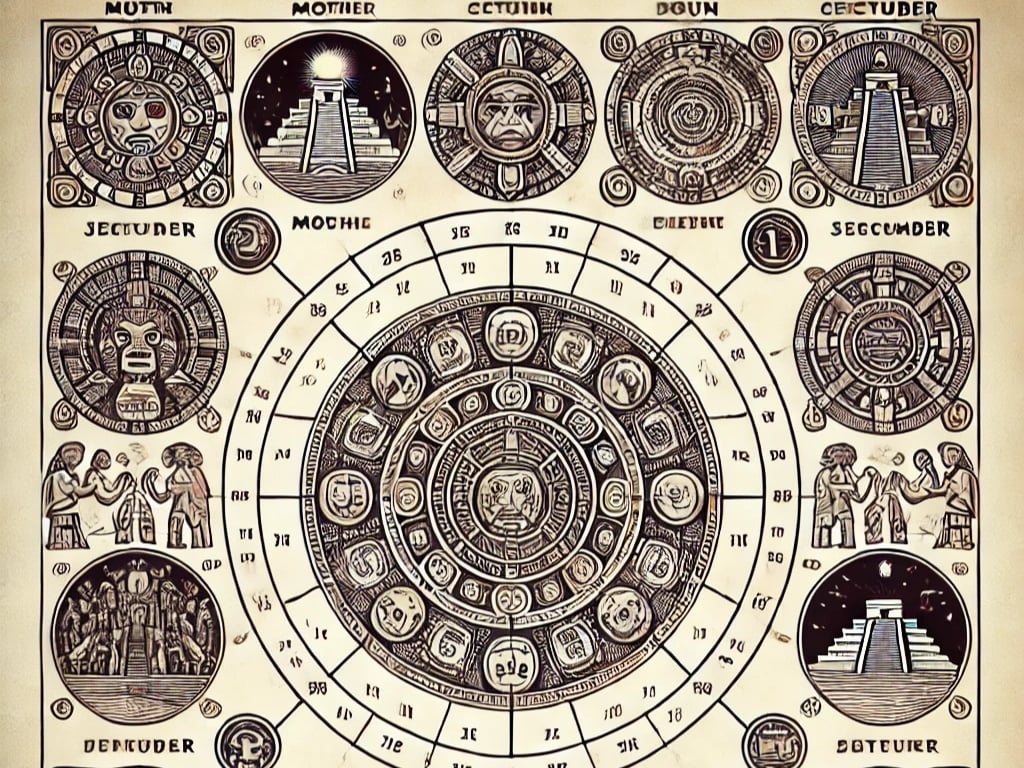
In fact, the Mayan 13th Lunar Calendar, also known as the Western Farmer's Calendar, not only emphasizes the importance of living with the flow and whether or not an individual is living out his or her own destiny, but it also serves as a reference for a day's living by observing today's imprints. Do the elders in your family look through the Lunar Calendar in the cupboard when deciding on dates for weddings, funerals, celebrations, or even moving? The Mayan 13 Lunar Calendar has a similar function!
Where do I look up the Mayan calendar?

Each totem, together with its tonality, forms a seal, so after understanding that there are so many combinations in the Mayan 13th Lunar Calendar, where should I go to look up my Mayan Calendar and get my seals? You can search for "Mayan 13th Lunar Calendar" on the Internet. Nowadays, there are many websites in traditional Chinese characters that also support searching the Mayan 13th Lunar Calendar, and as long as you enter your birth year, month, and day, you will be able to obtain your five seals and life wave symbols.
Who can I call to interpret my own Mayan calendar?

Nowadays, there are more and more people investing in learning the Mayan 13th Moon Calendar, and no matter which social media platform you search for keywords, you can find different teachers offering fee-based interpretation services. If you live in Taipei, you may want to refer to Cecilia's website, "Mayan 13th Lunar Calendar Interpretation by Cecilia".
Cecilia has interpreted the Mayan Calendar for more than 1,000 people in the past five years, and she is not only good at analyzing in a lively and interesting way, but also at discussing the difficult problems in life that we encounter nowadays. Through interpreting the Mayan Calendar, we can explore the confusion that is hidden in our hearts together, and loosen the knots that are in our hearts a little bit.
Not only Cecilia, there are different teachers all over Taiwan who study the Mayan 13th Lunar Calendar every day. Interpretation is never an easy job, and it takes fate and courage to hand over the imprint of one's life to another. If you are curious about how your life can "flow", then why not find a Mayan 13th Lunar Calendar teacher in the same county or city, and explore your life's original settings with your teacher!
Conclusion
The above is the Mayan Calendar Lazybones, a two-sevenths exploration of answers to frequently asked questions about the Mayan Calendar.
Whether it's the Human Chart, the Astrolabe or the Mayan 13th Lunar Calendar, each one is a way to get closer to our inner self. Whether you've been in touch with the mind, body and spirit, or you've never tried to understand yourself in a different way, why not think of it as a tool for "understanding yourself"? Throughout your life, you've resisted certain things and gotten yourself scarred; and when you got older and learned to go with the flow, you got unexpected results.
If you are interested in fortune telling, you may want to refer toTarot Card Reading Lazy Pack、Taipei Tarot Recommendations.
Living in a time of heightened anxiety, we rush to focus on things and people that are not our concern, adding to the emotional load. If the Mayan 13 Moon Calendar is a good medium for you to begin to bring your focus back to yourself, then I would encourage you to give yourself, and this calendar, the opportunity to put your life's imprint on the person in front of you, and begin a soul-searching conversation with them!